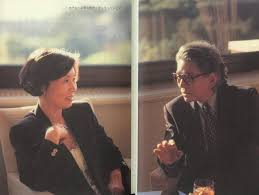
(title)”The Afternoon of Two Adults”
Hiroyuki Itsuki and Nanami Shiono
Two intellectual giants who see Japan today from historical and foreign perspectives
Hiroyuki Itsuki: Leading Japanese novelist : Hiroyuki Itsuki – Wikipedia
Nanami Shiono : Japanese historical writer and critic awarded the Order of Cultural Merit : Nanami Shiono – Wikipedia
Sekai Bunka Shakai 2000
(Kadokawa Bunko, 2003)
@The parts that left impressions on me
It is a dialogue between Hiroyuki Itsuki (I) and Nanami Shiono (S).
-S: When you live in a foreign country for more than 30 years, you are still trained. A foreign country, when you live there, that’s a lot of things.
-I: In short, it is a society where you cannot live unprotected.
-S: There are foreigners, including drugs and illegal immigrants (modern Rome).
-S: Ancient Romans ate a lot of fish.
-I: Agrarianism is a sign of peace.
-I: The Ottoman Turks were good at controlling other peoples.
I: The influence of ancient Rome and Arab-Islamic influence has left a tremendous mark on Europe.
-S: Japan’s failure was to recruit only those with good test scores to the Ministry of Finance and other central offices, and not to bring in Gentiles.
-S: How dare the Christians destroy all that was Roman!
-S: Rome has had seven faces: Ancient, Late Ancient Christian, Medieval, Renaissance, Baroque, Goethean Ruins of Rome, and Modern. It’s interesting because it’s a mixed bag.
-I: Children give their parents endless pleasure until they are about five years old.
-S: Discipline should be done at home, not at school.
-I: Children who were so free become useless when they go to junior high school, high school, and college. I think that the current school education in Japan is ruining students. However, the intellectual level around junior high and high school is astonishing.
-I: The modern university in Japan is a place to unwind and relax. It is only after you get a job that your social education begins.
-S:In Italian language courses, students learn mainly literary history and composition.
-I: The French teach and train their students to present their ideas in a logical and orderly manner that makes sense to everyone.
-S: You must persuade the other person in order to make him or her feel better. Socrates’ dialogues are the textbook.
-S: Nowadays in Italy, a good speaker is very popular. In other words, a politician who can express himself.
-I: Japan is a country where talking is not good for you.
-S: Japanese politicians who can’t speak well should ask for a good writer.
S: Spartans are the do-what-you-say type, and Athenians are the not practicing what one preaches type. European history is eloquent all the time.
-I: It is better to think of history as a fiction, a story. History is a human drama, a world of imagination.
-I: Genes called seemingly useless junk are doing important work (Susumu Tonegawa – Nobel Prize winning scientist).
-S: My parents’ house had only a little money, but there was no shortage of books and movies.
-I: For opera, the trick is to create your own favorite singer. As for paintings, I think about which one to steal (to hang in my house).
-S: The difference between polytheism and monotheism is whether you recognize the other’s religion or not.
-S: Japan should consider its own advantage of being polytheistic and non-Christian.
-S: In the East, there is no religious conflict.
-S: The great thing about Buddhism is the depth of its salvation.
-I: If politics and economics are the gas pedal, religion is like the brake. Both are important.
-S: Literature and religion are there to save one lost lamb. History and politics are for the 99.
-S: Mr. Itsuki is the only person in Japan who single-handedly represented the times.
-S: I want to stimulate my readers to think.
-S: I wrote about the Romans from their perspective, from the same point of view. (her book “The Story of the Romans”).
-I: Isn’t man a being kept alive by something greater?
-I: In life, there is no one who really understands you. You should be happy if there is one person who understands you just a little.
I: For the past 50 years since the end of World War II, we Japanese have been living in a Western-style, but spiritless society.
-S: Japanese people should tell Westerners that the Japanese spirit has something in common with the Western spirit.
-I:We are being crushed by the current global=American standards.
-I: Japan has been a repeat of going out with a bang and coming back with a bang. War, bubble, collapse, etc. We should seek a way of doing things that suits us.
-S:There are people who work hard when given a chance, and people who work hard when assured of stability. The latter has led Japan to date. In Europe and the U.S., only a few highly productive people have led the way.
-S: Globalization has brought about the rise of the weak and the strong. There will be dropouts. But it is our role to say that it is not a dropout.
-S: It is foolish managerialism to abolish lifetime employment altogether. They don’t understand that when you give stability, there are people who will do just fine.
-S: Living abroad, I have seen Japanese people with little ability in diplomatic missions and companies put on a big face (the idea that foreign countries are superior to Japan).
-S: Japanese are susceptible to being bad-mouthed. They do not recognize the value of bad language and do not like controversy.
-S: Like Ryotaro Shiba’s “Clouds over the Hill,” we are now at the top of a hill and don’t know what to do in the mass of clouds.
-I: Ms. Shiono may live internationally, but you are a patriot indeed.
-S: We should let Westerners know that Japanese people are not special.
-S: What the Japanese make is uninspiring and lacking in individuality. Yet, they are unbreakable. This is important, and 80% of the people should do it, but the rest 20% should make something intoxicating.
-S: Japan is now considerably despised. That is the danger.
-S: Venice and France, which created the medieval Renaissance, were filled with people who thought that “property is brains.
-S: Caesar did not get angry. He thought that when we get angry, it’s because we think we’re equal (to the other person).
-S: Philosophy is the study of how to live beautifully until death.
-I: “The Story of the Romans” has made a great sensation in Korea.
-I: Japanese people are generally childish.
-S.I.: Itsuki’s works give people healing and Shiono’s give encouragement and stimulation.
-I: Ms. Shiono is a genius agitator and it has been her time since the 1980s, and it is still her time.
-S: Writing conveys not only meaning but also a real voice.
-I believe that it is human emotion that drives history.
@My comments
These two are very fascinating. Itsuki was 68 years old when this book was published, and Shiono was 63.
Their accumulated culture (knowledge of history and contemporary affairs) is overflowing in the dialogue. Both continue to stimulate the public. Itsuki with his novels and criticism, Shiono with his historical novels and criticism.
Their personalities are yin and yang, but they are in great harmony.
This book is a wonderful book in which these two fascinating characters have a conversation in Rome, Shiono’s hometown.
The conversation led me to Itsuki’s “The Gate of Youth” and two more books of Shiono’s criticism (“The Shape of People” and “To the Men”) . Both lived up to my expectations.
