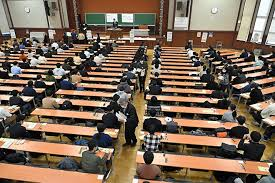
In Japan, students are told to “just study” until high school.
Studying is for the purpose of sorting students into different levels until they enter universities.
It is considered to be something to endure even if it is boring in order to get into a university that is considered to be as good as possible (It seems to be even worse in Korea and China).
The content of the examination study is 5 or 3 subjects such as English, mathematics, nationality, social studies, science, and so on.
But isn’t this strange?
Studying is supposed to be useful for a long life and to know the joys of life.
@There are many things that are missing from the study until high school.
-The lack of a work ethic: Work and occupation are important things that will affect one’s entire life, but nothing is taught until high school, and usually the teachers don’t know about it. They start job hunting around their junior year of college. After graduating from college, you will be in the job market for more than 40 years. What are they trying to show you by suddenly teaching you how to do job interviews, etc.?
You don’t learn about the company: what kind of business they are in, what they do, what is the difference between small and medium-sized companies and large companies, what is the difference between a venture company and a large company.
What is the difference between a large company and a small company, and what is a venture company?
-There are no role models of people who are living the ideal life.
-The one-time entrance exam that determines your entire life: the pointlessness of fostering a lifelong sense of superiority or inferiority about failing or being accepted: the foolishness of having the standard for judging ability determined at age 18, when there could be other indicators ,and no opportunity for exams at other times in one’s life.
-Lack of awareness that studying is a lifelong process: Japanese people do not study after entering the workforce. University is essentially something you can go to any time and go to as many times as you want. (Note 1)
-Vague reasons for applying to universities: Students have to choose a department without knowing what they are going to study.
-Not being taught about health and body, doctors and hospitals, and the social insurance system, which are important in life.
-They are not taught about love and marriage (sexuality): prestigious girls’ and boys’ school students do not know how to date and judge their partners based on appearance alone.
-They are not taught about economics: lifetime income, house, real estate, stocks, retirement, etc. are the foundation of life, but they are not taught.
-No opportunity to think about happiness theory, i.e., what is important in life and what is human happiness. (Note 2)
-Lack of opportunities and attitude to think about society and oneself: Japanese politicians are overwhelmingly inferior in terms of their qualities from an international perspective.
-Little teaching of the joys of sports, music, art, and other forms of art.
-No teaching of the significance of literature, movies, etc.: This is the reason why so many boring people are being produced.
-Not taught how to relate to others: Human relations problems are common in Japanese companies.
(Note 3)
-Religion is not taught. This is why many people easily join new religions or turn to religion to solve their problems.(Note 4)
@The biggest flaw of the current Japanese examination system is the attitude of accepting what is given without thinking about life.
Such thinking is fostered when people think that studying is such a thing.
Japanese are obedient and rule-abiding. Foreign tourists are surprised to learn that only Japanese people stop when the traffic light is red, even if no cars are passing.
-What is frightening is that these things are not taught even at university. They improvise themselves somehow and waste a lot of time when they learn by making mistakes.
-The scary thing is that the above is not taught when you enter college. You somehow improvise and act on your own, and waste a lot of time when you learn by making mistakes.
@Chomin Nakae: “Ichinen yu han” (A Year and a Half) (Classics New Translation Library), Kobunsha, 2016. From ancient times to the present, there has been no philosophy in Japan. This is the root of all disease.”
- This fact seems to remain unchanged to this day.
@Masahiko Fujiwara: “The Young Mathematician’s America”, Shinchosha, 1981, p251~p254
The following is a long quotation from the book:
It is that they (Americans) did little study-like learning before their high school years. The first-year college students’ knowledge of mathematics, history, geography, and science in general is astonishingly poor. It is lamentable.
So what was taught in schools from elementary through high school?
American schools do more than cram knowledge:
-How to work in harmony with others.
-How to express oneself logically.
-How to think and deal with problems when they arise.
-How to explore and develop issues in a discussion.
They seem to focus on the basics of education such as these.
It seems that while they are far behind Japanese students in terms of knowledge, they seem to be much more mentally mature.
It is an interesting phenomenon that they seem to be much less mature mentally than Japanese students, even though they are much less knowledgeable than Japanese students. The problem is that this difference is not limited to students.
students, but also to the general public at large.
Even a housewife who can’t do arithmetic is surprisingly solid and firm in her thinking, and when you listen to interviews with politicians and athletes, they are certainly articulate and well-reasoned.
If you were to gather an average Japanese and an American and test them on their knowledge, the American would appear inferior, and the Japanese would be no match for them in a discussion.
The difference is clearly due to education.
Both types of education have their advantages and disadvantages, but one thing I feel is that while knowledge comes naturally without being taught in school, logical thinking and expression are more difficult to acquire later in life if not acquired at a young age.
However, this problem is very complicated in Japan because it is closely related to the social phenomenon of exam hell.
Thus, because they have not studied at the stage of so-called “study until high school,” many of them have a feeling similar to that of longing for study when they enter university. They are not exhausted by studying for entrance exams, as is the case with new students in Japan. So, they start studying very energetically.
This is the end of the quotation.
@Not everything about the U.S. education system is great.
I believe that the conventional Japanese examination system is completely rusty because it has been following what has been done in the past under the old system created based on the idea of “catch up with and overtake the West” and that from now on, studying should be based on the premise that studying is something that is useful and fun throughout life.
7/20/2023
